
Theresa Gabrielli
December 1, 2025
Building airplanes is no easy feat. Aerospace engineers are always looking for new and innovative ways to make planes lighter, stronger and safer – without incurring higher costs. Some of the more costly errors happen when parts come off the manufacturing line with unexpected deformations. MSE graduate students Huilong (Max) Fu and Kendall Johnson in the Navid Zobeiry lab have found a new way to use AI tools to figure out what conditions cause these defects in composite material parts, and how to prevent them from forming in the future.
Currently, defect mitigation involves conducting tests called high-fidelity Finite Element process simulations, followed by physical experiments. These tests simulate how materials will behave under specific manufacturing conditions and are generally well regarded for their accuracy. However, running these simulations is both time-consuming and labor-intensive.
Fu and Johnson have developed a new hybrid method that combines two existing predictive tests: physics-based simulations and data-driven modeling. Their method involved running over 10,000 quick computer simulations that modeled how small changes in things like process, heat and tool shape affected the final part shape, then used those results to train a neural network. Then they looked at which manufacturing conditions had the biggest impact on deformation and used a statistical method to analyze which combinations of those conditions were most likely to cause specific defects. This unique mixture of simulation, AI modeling and analysis could prove immensely useful for aerospace composite manufacturing, as these preliminary results show high accuracy while being relatively quick and easy to implement in the real world.
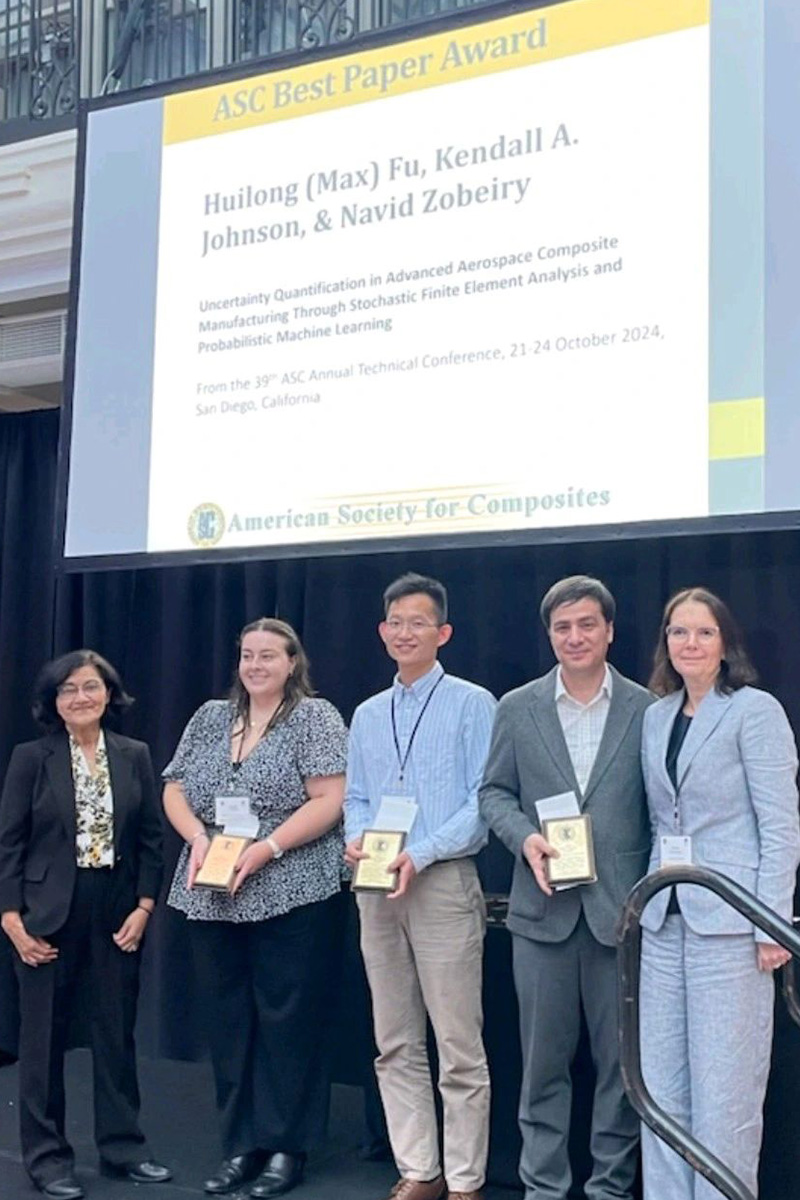
Johnson, Fu and Zobeiry accepting the ASC Best Paper Award
“Instead of treating material and process variations as noise, we model them directly to understand their impact on composite part distortion,” said Fu. “This approach allows us to identify the most influential factors and predict a realistic range of outcomes, helping engineers achieve more accurate, efficient, and reliable composite manufacturing.”
Johnson added, “Going into the project, I expected that using simplified simulations might limit the accuracy, but the neural network ended up capturing the key trends incredibly well. It was also really interesting to see that only a few parameters, like temperature and tool geometry, were responsible for most of the variation in part shape.”
In October, their paper describing this new approach was awarded the American Society for Composites (ASC) 2024 Best Paper Award for Breakthrough in Aerospace Composite Manufacturing. Every year, the ASC Awards Committee chooses one paper presented at their annual conference that demonstrates the most innovative and impactful research in composite materials and manufacturing. Fu and Johnson’s paper, “Uncertainty Quantification in Advanced Aerospace Composite Manufacturing Through Stochastic Finite Element Analysis and Probabilistic Machine Learning,” was selected from over 300 other submissions.
“It’s a great honor,” said Fu. “It also brings visibility to our ongoing research at the UW Composite Group, opening opportunities for collaboration and support for developing AI-assisted design tools for aerospace materials and others.”
This work was funded by Toray Industries and the University of Washington.