
September 23, 2026
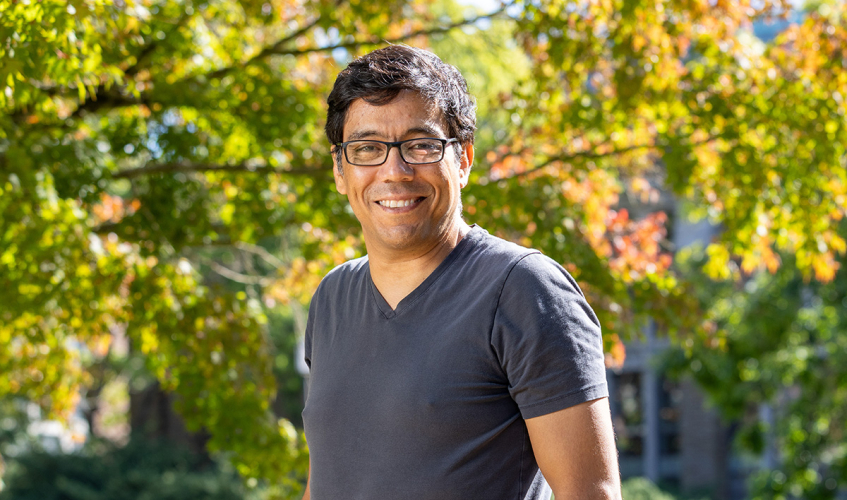
On September 1, Juan Carlos Idrobo began his appointment as the chair of MSE. But who is the person behind the title? Get to know the new chair of the department below!
Can you tell us your hometown, and a favorite memory you have from there?
I was born in Quito, Ecuador. My favorite time was probably the summer. Ecuador has very good weather, and in the summer, you can go rollerblading in the city or hiking in the mountains.
How did you become interested in materials science and engineering?
My Ph.D. research was in electron microscopes, and to use electron microscopes, you need materials to look at, so that is how the materials science aspect of my research came to be. I look at materials at the atomic scale and do imaging to know where the atoms are, and spectroscopy to understand what electrons do in terms of materials properties.
How did you end up at the University of Washington?
In 2020, during COVID, I watched a workshop organized by the condensed matter physics group at Princeton. [Former UW MSE professor] Xiaodong [Xu] gave a talk, and the things that he wanted to work on with his research were exactly the same things that I was interested in, but instead of what he was doing with optics, I was doing with the electron microscope.
So when I heard there was an open position here, I looked at the profile of the university, which professors were here and the research they were doing, and I saw some excellent opportunities for collaboration. I would also be able to add value to the university, since at the time, electron microscopy for materials science was non-existent. It would be an opportunity to contribute to the scientific portfolio of the university, to change the landscape and make the University of Washington a science powerhouse.
What excites you most about the chair position?
I’m excited about the opportunity to serve the department. I believe a great university empowers students to think critically and independently. Our faculty and staff are here to support their success. I want to create better opportunities, provide stronger resources and equipment for research, and help make our department known for both our students’ achievements and the research we produce.
What are your main goals or hopes for the department under your leadership?
I think we need to be more cohesive. The nature of materials science is that we are working in different aspects of the materials science field. As a consequence of that, our faculty don’t often collaborate or even see each other regularly. Our undergraduate students don’t know what the professors do unless they take a class that we are teaching. I want the students to know us in the first place, independent of whether we are teaching them or not.
I want to do something like a weekly social hour, so all the students – undergraduate and graduate – can come over and they can talk to us informally and get to know us better.
What does your life outside work look like?
I have a hobby that may be a little unconventional: I’ve practiced Jiu Jitsu for nearly ten years. I train two to three hours a day, and it has become an important part of my routine. Training in the morning leaves me calm, focused, and relaxed. It is like meditation.
When you are sparring with a 250-pound opponent, you are not thinking about the unfinished paper or the unanswered email. You are fully present and focused on the moment, otherwise you get choked! But getting choked is not a failure. You simply reset, try again, and learn from what happened.
That is also what I enjoy about experiments and learning about nature. Research rarely works perfectly on the first attempt. You observe, adjust, and try again, and each attempt teaches you something new. Jiu Jitsu reminds me to stay curious, persistent, and open to learning. Lessons that I try to bring to my role as educator as well.
What’s one thing that you’d like people to know about you?
I don’t take myself seriously. I don’t like formalities. If my students call me "professor" or "doctor," I jokingly call them "student." Then I invite them to call me Juan Carlos, while I call them by their names. I want everyone to feel comfortable, respected, and part of a friendly environment where they can ask questions and share ideas openly.