
Theresa Gabrielli
October 7, 2026
Batteries have become indispensable to everyday life. At the University of Washington, MSE graduate students in the Jie Xiao lab are taking battery technology to new heights and getting recognized for it.
A break with expectations
Most things get worse when they break. What if batteries do the opposite? In a paper published in Joule on October 6, third-year Ph.D. student Simon Danitz’s investigation shows a surprising discovery.
The little nub on the positive end of a battery is connected to many tiny ceramic crystals inside the canister. These crystals can crack with use, and the more damaged they become, the worse your battery life gets. However, in recent years, researchers have seen an unusual type of defect in this ceramic material called "gliding," in which parallel lines form across the crystal structure without causing cracks.
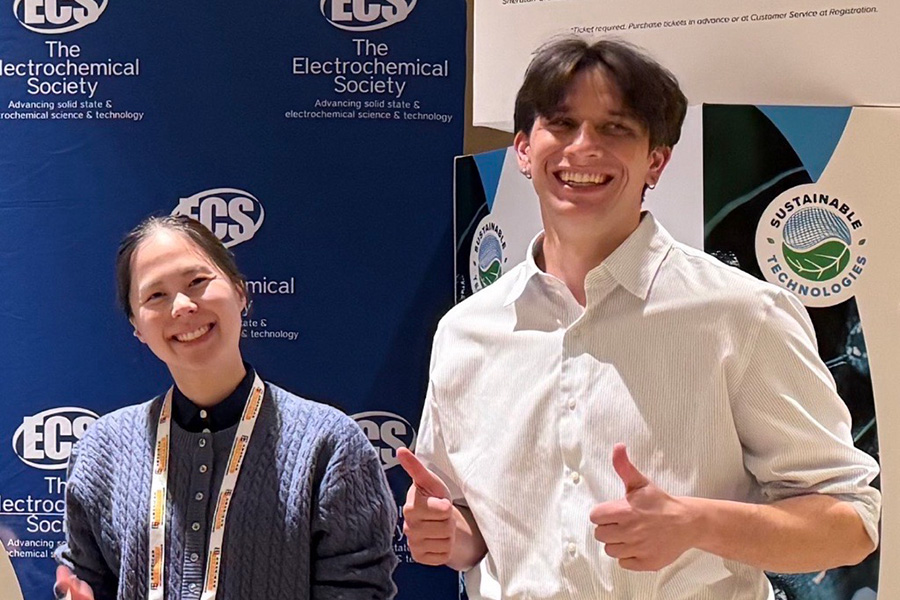
Danitz (right) at The Electrochemical Society Meeting last spring.
Danitz found that inducing this gliding defect during battery assembly counterintuitively improved battery performance. "We believe that glided crystals allow for planar defects to slightly increase the amount of strain, or stretching, the tiny crystals can undergo before they break," he said. "The findings are quite surprising. Normally, defects are assumed to be bad, so this is quite exciting."
His presentation of this discovery recently earned Danitz a Student Presentation Award from the A02 Whittingham Symposium.
More study of gliding at the atomic level is needed, but if these results hold, perhaps developing a way to intentionally create glided crystals could improve battery life and safety.
A novel use for existing tech
If you have a rechargeable device at home, that device most likely contains a lithium-ion battery. Our growing demand for batteries is pushing researchers to develop faster and more efficient methods of building them. Second-year Ph.D. student Harvey Yang thinks lasers could help.
Cathode materials are a central component of lithium-ion batteries. The production of lithium-ion cathode materials relies on lithium salt precursors, with Lithium hydroxide (LiOH) becoming increasingly popular among industrial battery manufacturers. However, LiOH tends to degrade quickly when exposed to air, introducing change in the compositions and properties of feedstocks used for synthesis.
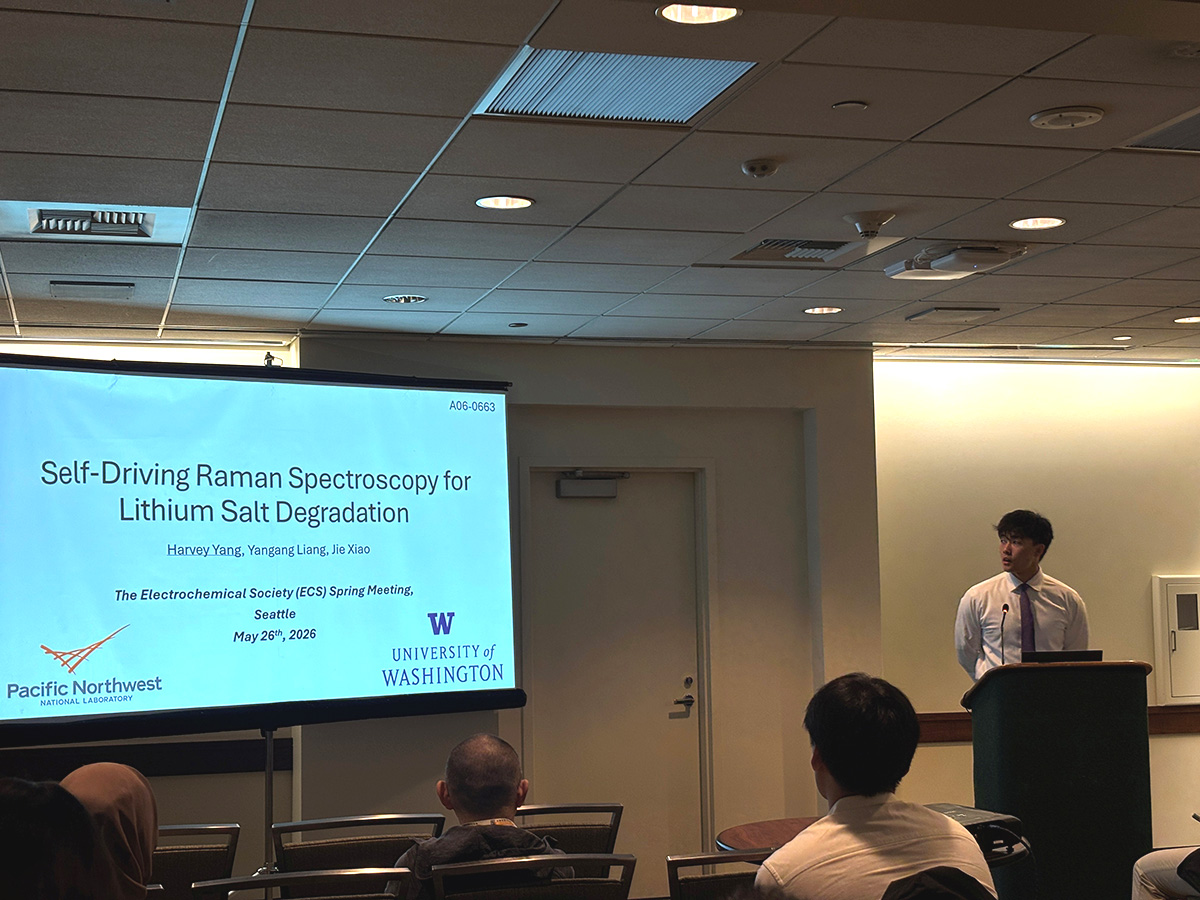
Yang presenting his research at the International Battery Workshop.
To mitigate this, Yang used method of analysis called Raman spectroscopy. In this process, lasers are shot into a sample, and the composition of the sample can be determined based on how the laser light is "scattered" back. Yang paired Raman spectroscopy with machine learning to both quantify and continuously monitor the lithium salt’s quality to provide process insights and feedback.
"Traditional machine learning methods for Raman spectroscopy have been used in organic materials such as in the biomedical or even the food industry. [Using it] for quality control of inorganic precursor materials is the first of its kind and can hopefully serve as a foundation for new ideas and applications across manufacturing environments," said Yang.
He presented these findings at the International Battery Workshop in May and received the Platinum Prize for his poster.
"I am extremely grateful to have received this prize. To me it serves as an indicator that I am on a good path, and I look forward to continuing my research for the upcoming years," he said.
Danitz and Yang were both supported by Pacific Northwest National Laboratory and the US Department of Energy Advanced Materials and Manufacturing Technologies Office. Danitz’s research was additionally supported by Cornell University and Lawrence Livermore National Laboratory.