
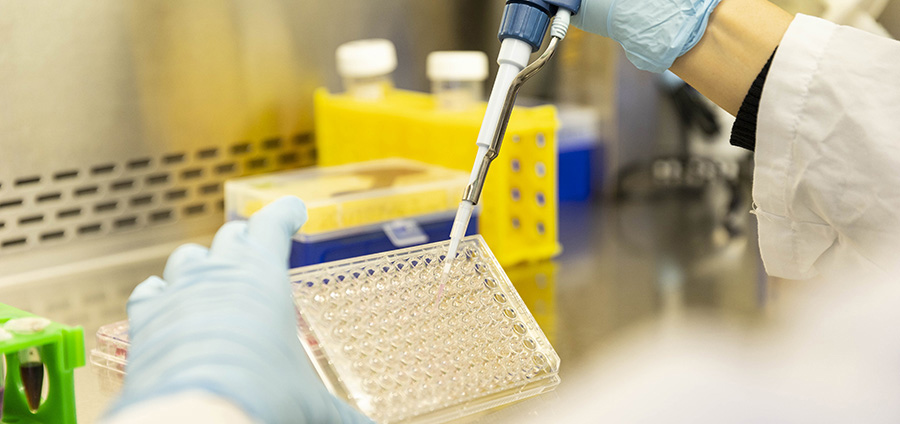
This concentration area focuses on the materials science and engineering of biomimetic, bioinspired and biomedical materials. Students will learn how materials science principles are applied to biology and medically-based systems. The study of biological systems offers many new insights and innovations in materials design for medicinal, environmental, structural, energy and information processing applications. Medicinal applications of new materials include medical diagnosis, imaging, adaptive delivery systems and drug therapy treatment.
Elective Options for Materials in Medicine and Biomimetics
Choose one course from the list on B.S. Degree Requirements. If you don't have a preference, selecting INDE 315 (Probability and Statistics for Engineers) is encouraged (NOTE: INDE 315 can count EITHER towards the Math Elective OR as one of the Engineering Fundamentals Electives, but it cannot count in both categories).
Choose two courses from list. Select courses that meet the prerequisites for the technical electives you want to take, if applicable.
| Course and credits | Title | Notes |
|---|---|---|
| BIOL 180 (5) | Introductory Biology - First quarter | |
| BIOL 200 (5) | Introductory Biology - Second quarter | Prereq is 1.7 in BIO 180; and CHEM 143, CHEM 145, CHEM 223, or CHEM 237, OR Concurrently taking CHEM 152, CHEM 153, or CHEM 155. |
| CHEM 223 (4) | Organic Chemistry - Short Program | Prereq is 1.7 in CHEM 152 , 153, or 155. |
| CHEM 224 (4) | Organic Chemistry - Short Program | Prereq 1.7 in CHEM 223 |
| Chem 162/165 (5) | General Chemistry - 3rd quarter | Prereq 1.7+ in CHEM 152 or 2.2 in CHEM 155 |
| CHEM 237/335 (4) | Organic Chemistry - 1st quarter | Prereq 1.7 in CHEM 153/155/162 for 237; CHEM 155/162 for 335 |
| CHEM 238/336 (4) | Organic Chemistry - 2nd Quarter | Prereq. 1.7 in CHEM 237, or 2.2 in CHEM 335 |
|
CHEM 312 (3) |
Inorganic Chemistry | Prereqs are CHEM 153/155/162; and CHEM 224/238/336. CHEM 165 students have already completed the equivalent of this course. |
| CHEM 317 (4) | Inorganic Chemistry Laboratory | Prereq is CHEM 165 or CHEM 312 |
| CHEM 452, CHEM 455, or CHEM 456 (3) | Physical Chemistry | Prereqs for all are CHEM 153, 155, or 162; MATH 126 or MATH 136; and PHYS 123. Counts toward Science elective OR Technical elective, not both. |
Choose 8 credits.
| Course and credits | Title | Notes |
|---|---|---|
| BIOEN 215 (3) | Introduction to Bioengineering Problem Solving | |
| CHEM E 355 (3) | Biological Frameworks for Engineers | Prereq CHEM 142, MATH 207 (or MATH 307), and PHYS 123 |
| NME 220 (4) | Introduction to Molecular and Nanoscale Principles | Technical elective requirements |
15 Credits, a minimum of 9 credits of MSE classes.
| Course and credits | Title | Notes |
|---|---|---|
| MSE 471 (3) | Introduction to Polymer Science and Engineering | |
| MSE 482 (3) | Biomaterials/Nanomaterials in Tissue Engineering | |
| MSE 483 (3) | Nanomedicine | |
| MSE 484 (3) | Electronic and Optoelectronic Polymers | Prereq CHEM 453 or CHEM 455 |
| MSE 498 (3) | Applicable topics on biology or biomimetics | |
| BIOC 405 (3) | Introduction to Biochemistry | Prereq BIOL 200; and either CHEM 223, 237, or 335 |
| BIOC 406 (3) | Introduction to Biochemistry | Prereq BIOC 405 |
| BIOEN 440 (4) | Introduction to Biomechanics | Course is joint with ME, but the ME section is closed to non-ME majors. |
| BIOEN 487 (3) | Bioengineering and Nanotechnology |
Prereq CHEM 142/143/145 and BIO 180 |
| BIOEN 504 (4) | Introduction to Technology Commercialization | |
| CHEM 452, CHEM 455, or CHEM 456 (3) | Physical Chemistry | Prereqs for all are CHEM 153, 155, or 162; MATH 126 or MATH 136; and PHYS 123. Counts toward Science elective OR Technical elective, not both. |
| ENGR 321 | Engineering Internship Education | Earn 1 credit for an internship 1-20 hours/week, and 2 credits for an internship 20 hours/week+. Can count up to 4 credits of internship towards your degree |
| ME 414 (4) | Engineering Innovations in Health | First course in the Engineering Innovations in Health (EIH) capstone program, but can be taken without committing to the EIH capstone |
Connection with Engineering Innovation in Health Care
Students interested in this concentration area may also be interested in the Engineering Innovation In Health Program, a three-quarter sequence (AWSp) of courses culminating in a completed solution to a healthcare challenge. Additional details can be found on the Capstone Projects page.